Lancet Study: Abortion does not improve prognosis for pregnant cancer patients | LifeSiteNews.com: A leading Belgian cancer physician will tell an international symposium in Dublin on maternal health this week that induced abortion does nothing to improve the prognosis of pregnant women with cancer. Described by The Lancet as “leading the agenda on cancer on pregnancy” Professor Frédéric Amant will say, “In the case of cancer complicating pregnancy, termination of pregnancy does not improve the maternal prognosis.”
'via Blog this'

Showing posts with label Research. Show all posts
Showing posts with label Research. Show all posts


Multiple Abortions Increase Risk of Maternal Death: New Danish Study
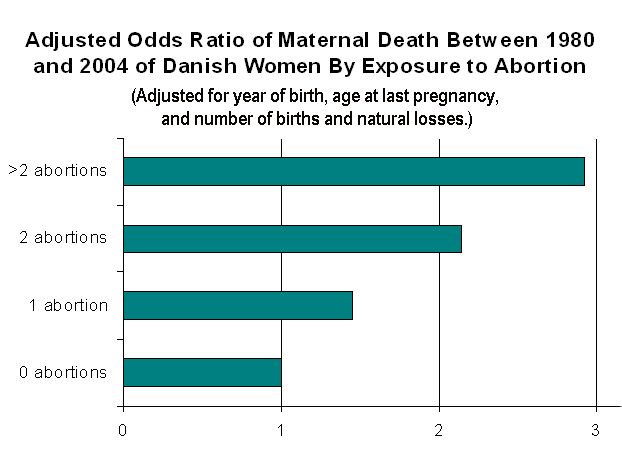
A single induced abortion increases the risk of maternal death by 45 percent compared to women with no history of abortion, according to a new study of all women of reproductive age in Denmark over a 25 year period. In addition, each additional abortion is associated with an even higher death rate. Women who had two abortions were 114 percent more likely to die during the period examined, and women had three or more abortions had a 192 percent increased risk of death.
Elevated rates of death were also observed among women who experienced miscarriages, ectopic pregnancies or other natural losses. Women with a history of successful deliveries were the least likely to die during the 25 years examined. Women who had never been pregnant had the highest mortality rate. Among women with a history of multiple pregnancies, women with a history of both abortions and natural losses, but no live births, had the highest mortality rate.
The study is the second record linkage analysis of Danish mortality data to be published this month. The earlier study was limited to comparing mortality rates following only the first pregnancy outcome. It found that abortion of a first pregnancy was associated with a higher rate of death compared to death rates among women who delivered a first pregnancy. The higher death rate among women who had abortions persisted for each of the first ten years following the first pregnancy outcome.
Finnish study: Repeat abortions linked to premature birth
BBC News - Repeat abortions linked to premature birth, study suggests: The more abortions a woman has before her first child, the more likely she is to give birth prematurely, a study 300,858 first-time mothers in Finland of has suggested. The study showed women were three times more likely to have a very premature baby, born before 28 weeks, if they had had three or more abortions. The report was published in the journal Human Reproduction.
From the introduction, emphasis added:
From the introduction, emphasis added:
"Induced abortion (IA) is one of the most common gynecological procedures performed on women but the impact of IAs on women’s subsequent childbearing has not yet been properly studied. . . . Many previous studies . . . have found a positive association between IA and risk of preterm birth or a dose– response effect (i.e. the risk of preterm birth increased with increasing number of IAs)."'via Blog this'
Danish study reveals higher maternal death rates following abortion
Medical Science Monitor: Medical records for the entire population of women born in Denmark between 1962 and 1991 and were alive in 1980, were linked to death certificates. Mortality rates associated with first pregnancy outcomes (delivery, miscarriage, abortion, and late abortion) were calculated. Odds ratios examining death rates based on reproductive outcomes, adjusted for age at first pregnancy and year of women’s births, were also calculated. Results: A total of 463,473 women had their first pregnancy between 1980 and 2004, of whom 2,238 died. In nearly all time periods examined, mortality rates associated with miscarriage or abortion of a first pregnancy were higher than those associated with birth.
Commentary by the American Association of Pro-Life Ob/Gyns:
'via Blog this'
Commentary by the American Association of Pro-Life Ob/Gyns:
A new study of the medical records for nearly half a million women in Denmark reveals significantly higher maternal death rates following abortion compared to delivery. This finding has confirmed similar large-scale population studies conducted in Finland and the United States, http://www.aaplog.org/complications-of-induced-abortion/induced-abortion-and-maternal-mortality/induced-abortion-and-natural-cause-maternal-death/ but contradicts the widely held belief that abortion is safer than childbirth. . . .
Why is this study important?
1) Record-based studies provide complete reproductive history data for all residents. There are very few record-based studies of mortality risks associated with reproductive loss available in the published literature. Without data-linkage to complete reproductive histories (as in this study), results are highly unreliable as prior research suggests as many as 73% of all pregnancy associated deaths are not apparent from death certificates.
2) This study eliminates the potential confounding effect of unknown prior pregnancy history by examining mortality rates associated with first pregnancy outcome alone.
3) No previous record-based studies have compared early induced abortions to later abortions. There is consensus that late-term abortions are associated with more physiological risks and higher rates of maternal mortality in the short term compared to early abortions. However, longer term mortality risks have not been previously examined with record-based data.From the Eliot Institute: Finding confirms similar large-scale population studies in Finland and US; contradicts widely held belief abortion safer than childbirth
'via Blog this'
Study: Abortion has more negative parenting impact than pregnancy loss
Study: Abortion has more negative parenting impact than pregnancy loss | ProLife NZ: A new review of studies examining various types of prenatal loss and the effects on subsequent parenting has concluded that abortion may be “particularly damaging to the parenting process.”
The article, published in Current Women’s Health Reviews, looked at already published studies on miscarriage, induced abortion and adoption. The author, Priscilla Coleman of Bowling Green State University, focused on psychological reactions to these various types of loss and discussed how they might affect a mother’s relationship with children born after the pregnancy loss.
PK Coleman, “The Psychological Pain of Perinatal Loss and Subsequent Parenting Risks: Could Induced Abortion Be More Problematic Than Other Forms of Loss,” Current Women’s Health Issues 5: 88-99, 2009.
'via Blog this'
The article, published in Current Women’s Health Reviews, looked at already published studies on miscarriage, induced abortion and adoption. The author, Priscilla Coleman of Bowling Green State University, focused on psychological reactions to these various types of loss and discussed how they might affect a mother’s relationship with children born after the pregnancy loss.
PK Coleman, “The Psychological Pain of Perinatal Loss and Subsequent Parenting Risks: Could Induced Abortion Be More Problematic Than Other Forms of Loss,” Current Women’s Health Issues 5: 88-99, 2009.
'via Blog this'
Skin cream made from aborted fetal skin cells
KLTV: Back in 2004, a married couple in Switzerland became pregnant. The couple's fetus was diagnosed with posterior encephalocele. The brain was deformed, the brain stem was underdeveloped and the retinas were not formed correctly.
Doctors said the fetus wouldn't survive, so the parents decided to terminate the pregnancy. But before doing so, the parents sent some of the fetus' cells to a cell bank. And cloned proteins from those cells were used to make NeoCutis skin cream.
. . . "Most physicians aren't going to know for sure how this was developed in its early stages," said Dr. Charles Kay, bioethicist at Wofford College. "It's important to note that fetal tissues, stem cells - these are not ingredients in these preparations. These are simply the origins of the cells which produce the proteins, and are in turn, the ingredients."
. . . NeoCutis is quite blunt about the use of fetal skin cells on their website. . . . The letters "PSP" on the front of the tube indicate the cream was made from "processed skin cell proteins."
Abstinence Education is Superior Sex Education Approach
NAEA - Congressional Report: Abstinence Education is Superior Sex Education Approach: The House Energy & Commerce Health Subcommittee released a report on Friday (July 6, 2012) entitled A Better Approach to Teenage Pregnancy Prevention: Sexual Risk Avoidance. The report examined the theory and the evidence behind both Sexual Risk Avoidance (SRA) Abstinence Education and Sexual Risk Reduction (SRR) "Comprehensive" Sex Education. It concluded that SRA is the superior approach and one that deserves policy priority.
- Read the Congressional report, A Better Approach to Teenage Pregnancy Prevention: Sexual Risk Avoidance here
- Read the NAEA report, Sexual Risk Avoidance Education: Considerations for Protecting Teen Health here
- Read the Abstinence Education Reallocation Act here
At the Center magazine Spring 2012 edition
- Centerboard: Hire a Leader and Get Out of the Way! By Tom Lothamer
- The Love Chapter: 1 Corinthians 13 By Dianne Pomon
- Help! My Client Is Single and Pregnant. What Do I Do Now? By Elaine Ham
- Deneutralized: Every Center Has the Potential to Shine! By Dr. Christopher Gustafson
- About-Face By Jeffrey D. Miller
- Shepherding Your Center By Pat Stonestreet
- Abortion Is Not Safer Than Childbirth: Get the Facts and Share the Truth By Thomas A. Glessner, J.D. and Audrey Stout, R.N. R.D.M.S.
- Being Real By Mark Hiehle
- You're Not Asking for Yourself By Ron Haas
- Marketing 101: The Mobile Wave By Jerry Thacker
IVF in young women tied to breast cancer: study
REUTERS - Women who go through in vitro fertilization (IVF) early in life are at a higher risk of developing breast cancer compared to those who dont undergo the treatment, according to an Australian study. But the findings, based on a study of more than 21,000 women and published in the journal Fertility and Sterility, cannot determine whether IVF contributed to the cancers or whether something else could explain the risk.
Roughly 1.7 percent of the 13,644 women who only used fertility drugs without IVF ended up developing breast cancer by the end of the study. That figure was about two percent for women who used fertility drugs and underwent IVF - a difference that researchers said wasnt statistically significant. When they divided the women into different age groups, though, that changed. Women who started taking fertility drugs around their 24th birthday and went through IVF had a 56 percent greater chance of eventually developing breast cancer compared to those in the same age group who only went through fertility treatments without IVF. But there was no increased risk for women who started fertility treatments when they were about 40 years old, regardless of whether they had IVF or not.
A possible reason that younger women see an increased risk of breast cancer is that they are exposed to higher levels of circulating estrogen during their cycles of IVF treatment. The development of breast cancer is linked to estrogen exposure and the longer one is exposed, the greater the risk. In an IVF cycle there is a short, but significant elevation in circulating estrogen, and whether this is linked to the observations found in the study is not clear at this time.
Editor: I Googled "IVF and breast cancer" and there were 275 news items about this already within just over 24 hours. Meanwhile, the abortion/breast cancer link gets scant attention. [Corrected comment.]
Study Shows Women Confident in Decision to Abort, Not Necessarily Informed
Study Shows Women Are Confident in Decision to Abort, Not Necessarily Informed: A new study by the Guttmacher Institute shows that women may be confident about their decision to abort their baby – but not necessarily informed. . . . [H]aving confidence does not mean that people have armed themselves with any amount of beneficial, tangible knowledge.
The study, in the June 2012 journal Perspectives on Sexual and Reproductive Health, looked at the “attitudes,” not the knowledge, of women who received abortions at one U.S. clinic. Data was taken from the pre-counseling needs assessment and clinical intake forms of over 5,109 women (5,387 abortions) in 2008. Researchers did not speak to any of the women. The results of the data evaluation showed that “[f]or 87% of the abortions sought, women had high confidence in their decision before receiving counseling.” The study results did not indicate a level of education regarding the stages of fetal development or the abortion process itself.
The study, in the June 2012 journal Perspectives on Sexual and Reproductive Health, looked at the “attitudes,” not the knowledge, of women who received abortions at one U.S. clinic. Data was taken from the pre-counseling needs assessment and clinical intake forms of over 5,109 women (5,387 abortions) in 2008. Researchers did not speak to any of the women. The results of the data evaluation showed that “[f]or 87% of the abortions sought, women had high confidence in their decision before receiving counseling.” The study results did not indicate a level of education regarding the stages of fetal development or the abortion process itself.
Editor: Obviously, women are not so settled in their minds about their abortion decisions. Otherwise, sidewalk counselors -- who do speak to women -- would have no success.
Analysis: Biased Guttmacher Study Claims Women Confident of Abortion Decision
'via Blog this'
Analysis: Biased Guttmacher Study Claims Women Confident of Abortion Decision
'via Blog this'
Wantedness and coercion
"Key Factors in Understanding Women’s Mental Health After Abortion," by Martha Shuping, M.D., Association for Interdisciplinary Research in Values and Social Change Research Bulletin, Vol. 23, No. 2, Fall 2011
Post-abortion suffering
A psychiatrist looks at the effects of abortion - downloadable brochure from FRC
A Serious Misrepresentation of the Relative Safety of Induced Abortion Compared to Childbirth
A Serious Misrepresentation of the Relative Safety of Induced Abortion Compared to Childbirth Published in a Leading Medical Journal | Wecare: Download PDF here
What if you are the author of a major article in a peer reviewed journal that disagreed with the contention that abortion is safer than childbirth, and you write a letter of objection to the editor of "Obstetrics and Gynecology?' Does your letter get printed? Of course not. There isn't room. See below: The letter is from Dr. David Reardon.
Dear Editor,
The comparison of abortion and childbirth mortality rates conducted by Raymond and Grimes(1) uses an "apples versus oranges" comparison which has long been discredited.(2)(3) Indeed, the CDC acknowledges its abortion associated death totals are not only incomplete but are also "conceptually different" than maternal mortality rates.(4)
Fortunately, several high quality record linkage studies, which apply a consistent and uniform standard for identifying and comparing deaths associated with different pregnancy outcomes,(2) have been conducted both in the United States(5) and in a series of studies in Finland.(3)
These studies have consistently shown higher rates of death associated with abortion compared to (a) childbirth, (b) miscarriage, and (c) not being pregnant. While a large portion of increased mortality risk is attributable to elevated rates of suicide and deaths attributed to accidents, abortion is also associated with significantly higher mortality rates for death from natural causes.(2)(5)
That these record linkage studies were completely omitted from this purported "review"(1) is inexcusably dishonest. This "apples versus oranges" retread appears to be nothing more than a publicity stunt designed to generate misleading headlines about abortion being "safer" than childbirth.
David C. Reardon, Ph.D.
(1) Raymond, Elizabeth G.; Grimes, David A. The Comparative Safety of Legal Induced Abortion and Childbirth in the United States. Obstetrics & Gynecology. 119(2, Part 1):215-219, February 2012.The basic answer he received from the Green Journal was:"Your Letter to the Editor has been evaluated. We regret to inform you that we were not able to accept it for publication. It was declined on the basis of priority. Other letters were received on this manuscript and we only have limited space. Unfortunately, we can only publish a fraction of the letters received." To which Dr. Reardon replied:
(2) Reardon DC, Strahan TW, Thorp JM, Shuping MW. Deaths associated with abortion compared to childbirth: a review of new and old data and the medical and legal implications. The Journal of Contemporary Health Law & Policy 2004; 20(2):279〓327.
(3) Gissler M, Berg C, Bouvier〓Colle MH, Buekens P. Methods for identifying pregnancy-associated deaths: population-based data from Finland 1987-2000. Paediatr Perinat Epidemiol. 2004 Nov;18(6):448〓55.
(4) Elliot Institute. New Study Finds Women Are Three Times More Likely To Die After An Abortion: CDC Admits Its Abortion and Childbirth Mortality Statistics Are Not Comparable. Sept 9, 2005 Afterabortion.org http://afterabortion.org/?p=2493 Accessed, February 8, 2012.
(5) Reardon DC, Ney PG , Scheuren FJ, Cougle JR, Coleman, PK, Strahan T. "Deaths associated with pregnancy outcome: a record linkage study of low income women." Southern Medical Journal, August 2002, 95(8):834-841.
I understand the limitation of space. Can you assure me that the other, better written, letters address this review's failure to identify and discuss the six to eight record based studies out of Finland and the United States which demonstrate that abortion is associated with an elevated risk of maternal deaths compared to delivery?
Or is my letter being rejected to cover up the failure of your journal and peer reviewers to hold this "review" accountable for suppressing evidence which runs counter to "abortion is safe" mantra?
I am especially amazed that the record based studies of STAKES, the statistical analysis unit of Finland's National Research and Development Center for Welfare and Health, are being systematically ignored even though their findings have been confirmed in an American population in our own study."
Dr. David ReardonNote: Dr. Reardon's letter was not printed in the March "letters" in OB & GYN. No letters referable to the Raymod/Grimes article were printed. Still possible to get in the April edition. We'll watch with you.
New China Study
Prolife OBGYNS – AAPLOG – American Association of Pro-life Obstetricians & Gynecologists » New China Study: There are several take-home messages from this study:
1) This study adds to the rapidly accumulating world literature on abortion and mental health. Even in a culture wherein abortion is widespread and is mandated by the government after women give birth once, the magnitude of psychological risks are comparable to those identified in other parts of the world (e.g., Australia, New Zealand, Norway, South Africa, US).
2) The 1st trimester of a later pregnancy may be the most difficult time for women, who have experienced an induced abortion, since the majority of abortions occur early in pregnancy.
3) The psychological experience of abortion is more likely to be associated with long-term psychological distress than spontaneous abortion.
Editor: I might add a few thoughts. One relates to the idea that in China, not only is abortion "widespread and mandated," it is not stigmatized by a religious or pro-life community. Another factor could be related to the horror of forced abortion. Imagine the anxiety that the one-child policy exerts on every pregnancy. Finally, the experience of abortion in China may be more horrific -- I don't know, but that could be a significant factor.
'via Blog this'
1) This study adds to the rapidly accumulating world literature on abortion and mental health. Even in a culture wherein abortion is widespread and is mandated by the government after women give birth once, the magnitude of psychological risks are comparable to those identified in other parts of the world (e.g., Australia, New Zealand, Norway, South Africa, US).
2) The 1st trimester of a later pregnancy may be the most difficult time for women, who have experienced an induced abortion, since the majority of abortions occur early in pregnancy.
3) The psychological experience of abortion is more likely to be associated with long-term psychological distress than spontaneous abortion.
Editor: I might add a few thoughts. One relates to the idea that in China, not only is abortion "widespread and mandated," it is not stigmatized by a religious or pro-life community. Another factor could be related to the horror of forced abortion. Imagine the anxiety that the one-child policy exerts on every pregnancy. Finally, the experience of abortion in China may be more horrific -- I don't know, but that could be a significant factor.
'via Blog this'
Chinese study finds link between previous abortion and depression among pregnant women
LifeSiteNews: The study found that pregnant women who had undergone an induced abortion of a previous pregnancy a year or more before their current pregnancy were 49% more likely to experience depression and 114% more likely to experience anxiety during their first trimester. If the abortion was more recent, the risk was 97% greater for anxiety in the first trimester, and 64% greater for depression during the second trimester. In comparison, the study found, women who had experienced a miscarriage did not appear to be at a greater risk for anxiety or depression than other pregnant women in the first and second trimester.
The researchers also cited a previous study which found that anxiety was particularly prevalent among post-abortive pregnant woman before the woman passed the gestational point at which the previous abortion had occurred.
Dr. Priscilla Coleman, a professor of Human Development and Family Studies at Bowling Green State University in Ohio, called this finding “disconcerting,” noting that “all the major body structures are formed during the 1st trimester and stress hormones may potentially harm the developing fetus.” In an analysis of the study, Coleman also noted that the findings were consistent with those of previous studies.
Dr. Priscilla Coleman Responds to Recent Media Attacks
Dr. Priscilla Coleman Responds to Recent Media Attacks | NRL News Today: "We responsibly addressed this error and the paper was never retracted by the journal. Interestingly the dozens of mainstream U.S. journalists who pounced on this situation and irresponsibly described the results as unreliable, invalid, debunked, etc., were absolutely silent when the meta-analysis was published last fall. This meta-analysis appeared in one of the most prestigious psychiatry journals in the world and the quantitative review incorporating data from 877,181 women offered the largest estimate of mental health risks associated with abortion in the world literature.
"A corrected error in a single study that reported associations between abortion and mental health is apparently more news worthy than a major meta-analysis."
'via Blog this'
"A corrected error in a single study that reported associations between abortion and mental health is apparently more news worthy than a major meta-analysis."
'via Blog this'
Abortion-mental illness link doesn't hold up, researchers find
Abortion-mental illness link doesn't hold up, researchers find | Fox News: A study purporting to find a link between abortions and mental illness does not hold up to scrutiny, according to a new report in the Journal of Psychiatric Research.
The original study, conducted by Priscilla Coleman of Bowling Green State University in Kentucky, has been a source of contention since its publication in 2009, when critics pointed out flaws in the statistical analysis. Those errors triggered a correction by Coleman and her colleagues, but outside researchers found other problems with the paper. Most importantly, they report in the February issue of the journal, the original researchers included mental health ailments not only after abortion, but all across the life span, making it impossible to know whether the psychological problems came before or after the procedure.
Dr. Coleman's response
'via Blog this'
The original study, conducted by Priscilla Coleman of Bowling Green State University in Kentucky, has been a source of contention since its publication in 2009, when critics pointed out flaws in the statistical analysis. Those errors triggered a correction by Coleman and her colleagues, but outside researchers found other problems with the paper. Most importantly, they report in the February issue of the journal, the original researchers included mental health ailments not only after abortion, but all across the life span, making it impossible to know whether the psychological problems came before or after the procedure.
Dr. Coleman's response
'via Blog this'
Abortion Is Safer than Childbirth?
Prolife OBGYNS – AAPLOG – American Association of Pro-life Obstetricians & Gynecologists » Abortion Is Safer than Childbirth?: The prominent original research article “The Comparative Safety of Legal Induced Abortion and Childbirth in the United States,” by Raymond and Grimes in the Feb, 2012, journal Obstetrics & Gynecology, rehearses the original mantra of the choice argument: “Abortion is safer than Childbirth.” To reach this conclusion, Raymond and Grimes employ statistical methodologies seen before, using inadequate or incomplete data, ignoring some important literature, and drawing general conclusions using limited and, we feel, inaccurate “facts.” AAPLOG finds this article to be a very serious distortion of reality as we understand the reality.
Previous articles on the same subject:
Get to Know WECARE: World Expert Consortium for Abortion Research & Education
About Us | Wecare: WECARE brings together credentialed scientists with a research program on the physical, psychological, and/or relational effects of abortion on women and those closest to them to engage in international research collaboration, scientific information dissemination, professional education, and consultation.
'via Blog this'
'via Blog this'
A Serious Misrepresentation of the Relative Safety of Induced Abortion Compared to Childbirth
A Serious Misrepresentation of the Relative Safety of Induced Abortion Compared to Childbirth Published in a Leading Medical Journal | Wecare: You need to read this 2 page commentary so you know how to refute the mantra's misinformation. This is essential information for a prolife professional to know. You need to know that the data reported by abortion clinics to state health departments and ultimately to the CDC significantly under-represents abortion morbidity and mortality for several reasons: 1) abortion reporting is not required by federal law and many states do not report abortion-related deaths to the CDC; 2) deaths due to medical and surgical treatments are reported under the complication of the procedure (e.g., infection) rather than the treatment (e.g., induced abortion); 3) most women leave abortion clinics within hours of the procedure and go to hospital emergency rooms if there are complications that may result in death; 4) suicide deaths are rarely, if ever, linked back to abortion in state reporting of death rates; 5) an abortion experience can lead to physical and/or psychological disturbances that increase the likelihood of dying years after the abortion, and these indirect abortion-related deaths are not captured at all.
We urge you: download this information, and get a basic handle on it. Abortion is NOT safer than childbirth!.
We urge you: download this information, and get a basic handle on it. Abortion is NOT safer than childbirth!.
Subscribe to:
Posts (Atom)